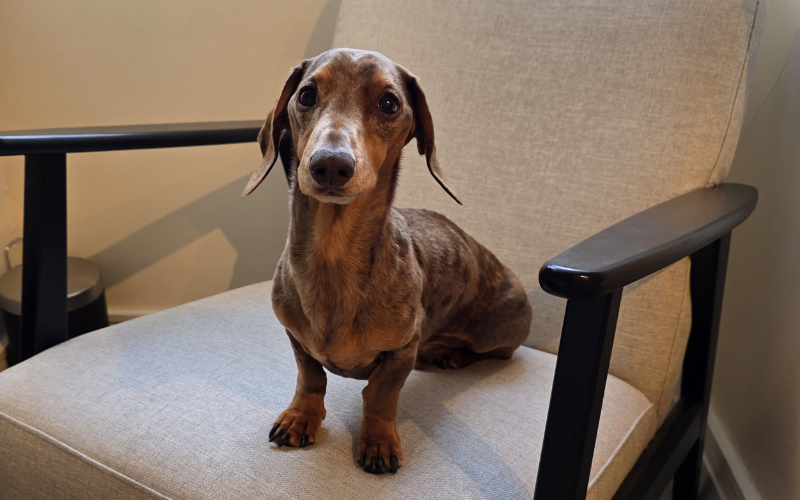
Meet Fonsie.
A four-legged invitation into the work.
Fonsie is a miniature chocolate dapple dachshund, and he's been part of this practice since the beginning. He didn't come with a plan - but it quickly became clear he was doing something in sessions that no technique, tool, or training had quite prepared me for.
Simpler than it sounds.
Animal-assisted therapy is an increasingly well-evidenced approach, particularly with children and adolescents. The presence of a calm, trained animal has been shown to lower cortisol, reduce anxiety, and create conditions in which young people feel safer and more willing to engage.
In practice, what this often looks like is simpler than it sounds: a young person who arrives guarded and reluctant finds it easier to settle when there's a dog in the room. The focus shifts, the pressure drops, and something opens up that might otherwise have taken much longer to reach.
What Fonsie brings to sessions
- A calming, non-judgmental presence
- A natural icebreaker for young people who find it hard to settle
- A focus for emotional expression, especially for those who struggle to talk about feelings
- A gentle anchor during difficult moments
- Moments of lightness and genuine connection
Animal-assisted therapy isn't a gimmick.
The dog isn't the therapist. The dog is a co-regulator - a living, breathing reason for an anxious nervous system to relax just enough for the work to begin.
It's not pet therapy
Petting a dog at the door of an office is lovely. Therapy with a dog present is structured, intentional, and follows the same clinical frame as any session.
Fonsie has a job
He's trained to settle, to be receptive, and to recognise stress responses. He chooses to be there - and he can excuse himself.
He's part of the room
Fonsie is part of how I work, so he's usually present rather than an add-on. If a serious allergy, a dog phobia or a strong preference means that won't suit, this may not be the right fit - and I'll gladly help you find someone who is.
Not for everyone - and that's part of the design.
Often helpful for
- Very quiet clients
- Severe social anxiety, ASD-aligned profiles
- Trauma where the body feels unsafe
- Bereavement, especially involving a pet
- School-refusing or treatment-reluctant teenagers
- Children who relate easily to animals
Where this practice may not be the right fit
- Severe allergies (no exceptions)
- Dog phobia
- Active distress where a stimulus would overwhelm
- Cultural or religious preferences not to share space with dogs
- Households where a parent isn't comfortable
Because Fonsie is part of the room, these are cases where I'll gladly refer you to a trusted colleague instead.
What a session with Fonsie looks like.
It varies - and that's the point. Some sessions, he's a quiet weight on a young person's feet. Some, he's actively part of the conversation.
- 00:00Arrival
Fonsie greets the young person at the door if invited. They lead the contact - he never imposes.
- 05:00Settling
He finds his spot - usually a low cushion near the client. The body language tends to mirror the room.
- 15:00Co-regulation
For anxious or trauma-affected clients, the presence of a calm mammal noticeably slows breathing and lowers shoulders. Real work begins.
- 35:00Material
Sometimes Fonsie becomes part of the material - projection, attachment, comfort. Other times he's just there. Both are useful.
- 50:00End
A goodbye on the young person's terms. For under-12s especially, this small ritual matters.
He's a colleague, not a tool.
Animal welfare is the foundation of ethical animal-assisted therapy. I follow UK best practice - the guidance of SCAS (the Society for Companion Animal Studies) and Pets as Therapy (PAT) - and run sessions that prioritise the dog as much as the human in the room.
- Maximum 4 sessions per day, with rest blocks between
- Park walks and downtime between sessions
- Veterinary review and ongoing welfare logging
- Insurance and certification specific to therapy-dog work
- "Off" days respected without apology
Questions families always ask.
Does my child have to interact with him?
Is he hypoallergenic?
What if he barks or interrupts?
Will he be at every session?
Does this cost more?
He's sat with a lot of young people through a lot of hard things.
And he takes it all in his stride - which, for a dog of his size, is quite something. If you'd like to know more about how animal-assisted therapy works, read my piece 'My Co-Therapist, Fonsie'. Or, if you're ready to find out whether working with us might be right for you or your child, get in touch.
woof.